
Under Catholic teaching the provision of support for destitute and in great distress was considered a Christian duty in accordance with the seven corporal works of mercy (feed the hungry, give drink to the thirsty, welcome the stranger, clothe the naked, visit the sick, visit the imprisoned, and bury the dead). In practice it was left to the priories and monasteries and other establishments of the various religious orders to provide practical support needed. The Reformation and the establishment of the Church of England led directly to the dissolution of abbeys, priories and monasteries and with it the supported that the destitute depended on.
During the Elizabethan period the issue of poverty became extreme and various attempts to deal with it culminated in the introduction of the Poor Law of 1601. The provisions of the 1601 Poor Law included setting a ‘poor rate’ for every parish, collecting the poor relief rate from property owners, the election of two Overseers for the administration of relief and ‘setting the poor on work’. Overseers reported to the local Justices of the Peace and were often reluctant to be appointed especially as the role was unpaid. They were responsible for working out how much money would be needed for the relief of the poor, collecting the money, distributing relief, and supervising the parish poorhouse.
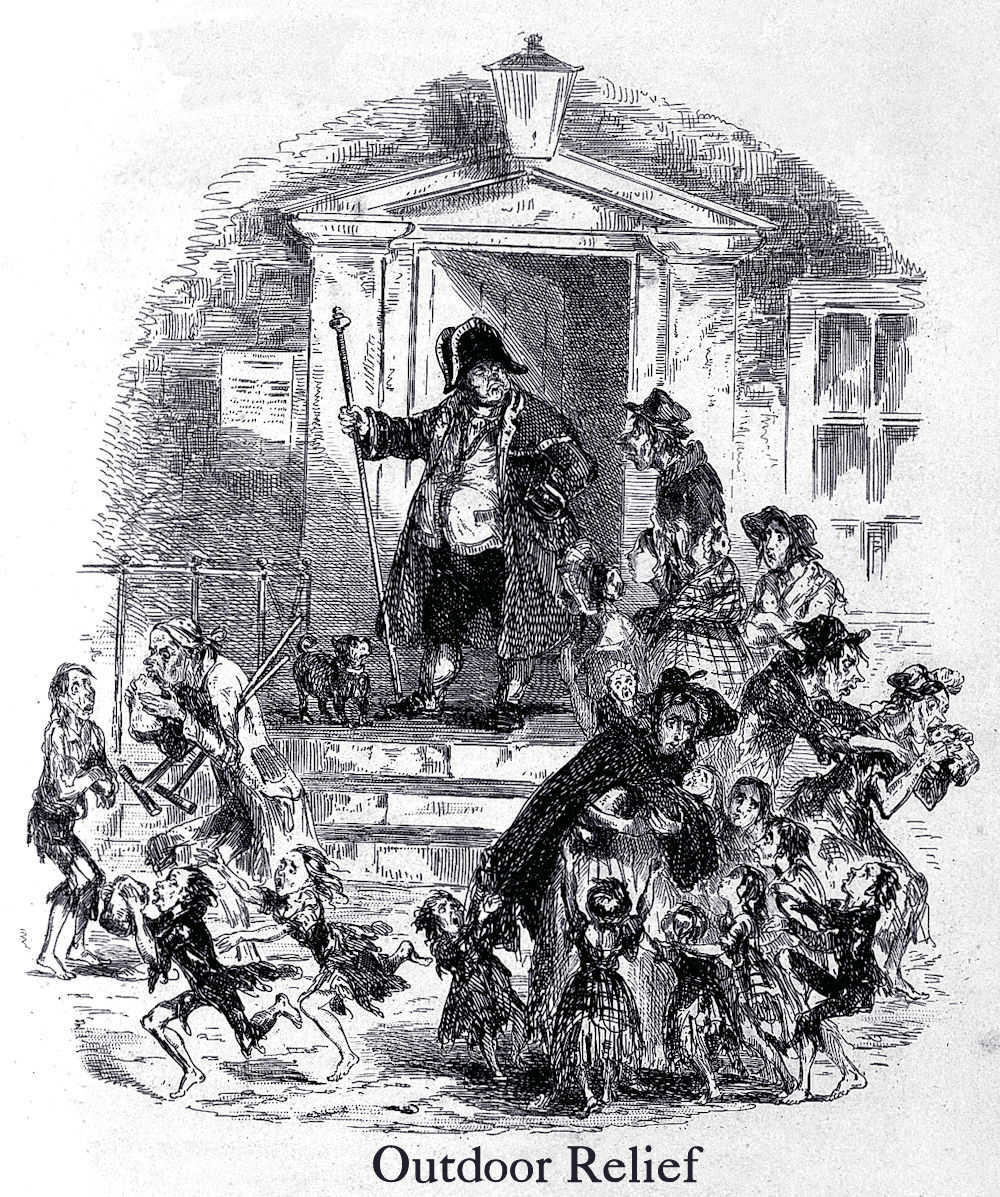 There were two forms of relief: Outdoor Relief where the poor would be left in their own home and money or more usually food and clothing would be ‘doled’ out, at this time it was the most common form of relief. Indoor Relief where the poor were taken into local alms houses, the sick were admitted to an infirmary (if it existed), orphans would be taken to an orphanage and the remainder, often referred to as ‘the idle poor’, were sent to work at the Poor House. The underlying intention of the 1601 law was to provide support for the ‘settled’ poor who through illness, trade depression or natural disturbance such as a very hard winter might find themselves out of work; it was assumed these unfortunates would accept any work offered.
The law was intended to discourage beggars, tramps and other undesirables. While the system seems harsh and inadequate to us it was better than no support at all however the main flaw was that there was mechanism to enforce it and as a result there were wild inconsistencies from parish to parish and from county to county. By the early 19th century the Poor Relief system was becoming unmanageable. A rapid increase in population, the return of injured and unemployed men from the Napoleonic wars, the introduction of new technology to replace agricultural workers, a succession of poor grain harvests and the introduction of the 1815 Corn Law (which succeeded in keeping grain prices high) meant the cost of Poor Relief increased fourfold in 20 years.
By the early 1830’s it was realised that the systems was unsustainable and following the recommendations laid out in a report by Royal Commission the Parliament passed the Poor Law Amendment Act in 1834 which led to the establishment of the workhouse system common throughout Great Britain during the Victorian era; to ensure consistent standards all workhouses would be subject to the control of the Poor Law Commission for England and Wales.
It should be borne in mind that the primary intention of the act was not to provide for the welfare of the poor but to deter people from seeking assistance and to this end conditions were very harsh. Parishes would be grouped together in ‘Unions’ with a single facility providing for all the needs of the Union. In 1837 the Haverfordwest Union was formed from 63 parishes to the north of Milford Haven and was overseen by a 67 strong Board of Guardians; similar arrangements were in place at Narberth and Pembroke.
Outdoor Relief was abolished and assistance only be given in the workhouse where conditions were so severe that
“Into such a house none will enter voluntarily; work, confinement, and discipline, will deter the indolent and vicious; and nothing but extreme necessity will induce any to accept the comfort which must be obtained by the surrender of their free agency, and the sacrifice of their accustomed habits and gratifications.“
It is important in this context to distinguish between poverty and destitution. The majority of people experienced a degree of poverty in the mid-19th century in that they had few if any luxuries, ate what they could afford, worked long hours in arduous occupations, and lived in poor housing most likely in dirty and unsanitary conditions; many children died before reaching adulthood. The destitute were not this fortunate, may not have had anywhere to live and frequently had nothing to eat.
But to the wealthy the poverty of working people was seen not just as desirable but as a necessity:
“Poverty is therefore a most necessary and indispensable ingredient in society, without which nations and communities could not exist in a state of civilization. It is the lot of man. It is the source of wealth, since without poverty, there could be no labour; there could be no riches, no refinement, no comfort, and no benefit to those who may be possessed of wealth.” (Patrick Colquhoun, 1806)
Leave a Reply